
Why Natural Frequency Matters in Vibration Isolation
When engineers design a vibration isolation system, they consider much more than equipment weight and anti-vibration pad dimensions.
One of the most important engineering concepts is natural frequency.
Understanding natural frequency helps consultants, contractors, and facility managers select vibration isolation solutions that perform efficiently throughout the life of the equipment.
What Is Natural Frequency?
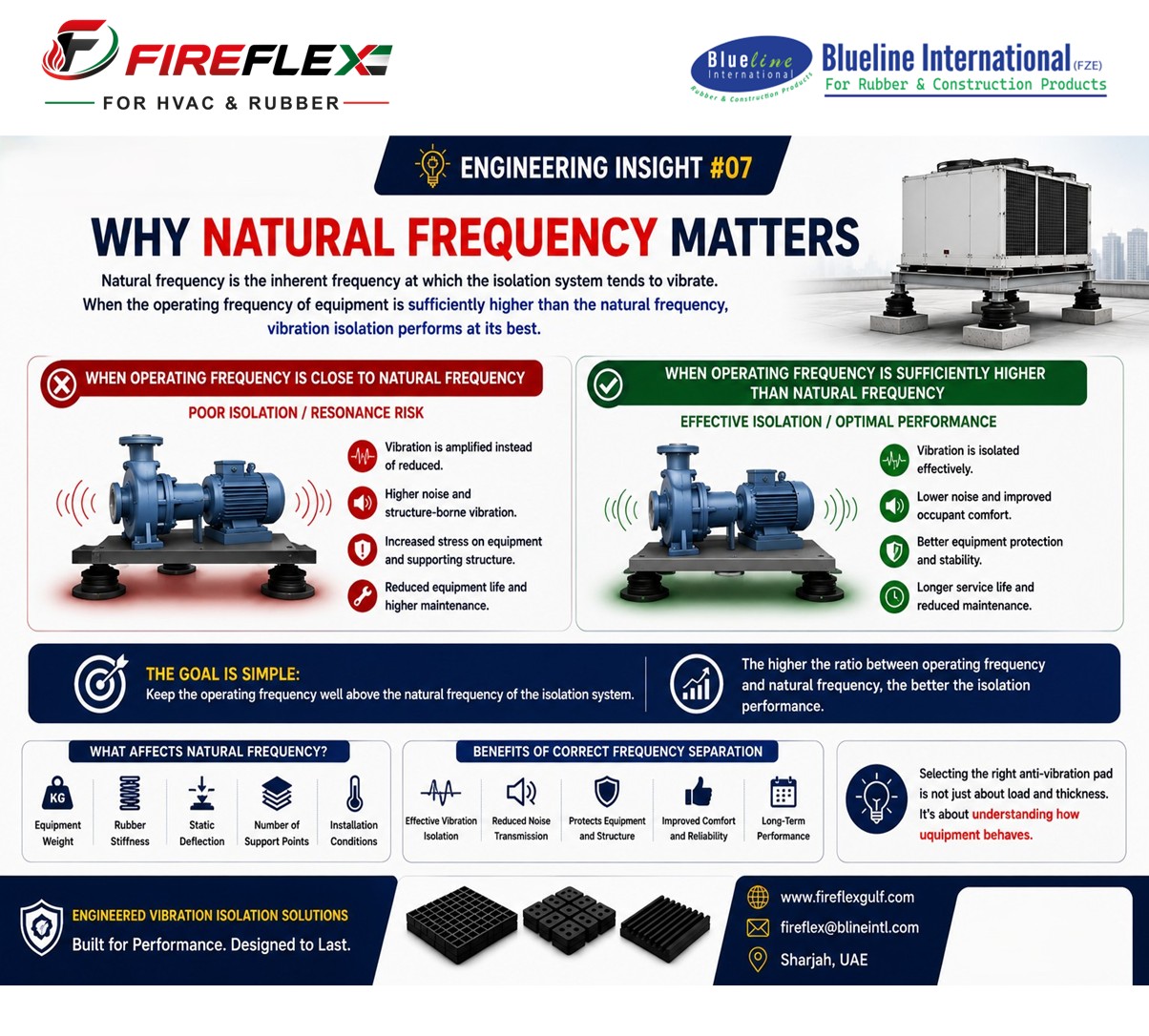
Every vibration isolation system has a natural frequency—the rate at which it naturally tends to vibrate when disturbed.
Likewise, HVAC and mechanical equipment operates at its own operating frequency during normal service.
For effective vibration isolation, these two frequencies should be sufficiently separated.
When they are too close, the isolation system may not perform as intended and vibration can be amplified rather than reduced.
Why Is Natural Frequency Important?
A properly selected vibration isolation system helps to:
- Reduce vibration transmission
- Minimise structure-borne noise
- Improve equipment stability
- Protect supporting structures
- Enhance occupant comfort
- Support long-term equipment reliability
Natural frequency plays a major role in achieving these outcomes.
What Influences Natural Frequency?
Several engineering factors affect the natural frequency of an isolation system, including:
- Equipment load
- Static deflection
- Rubber stiffness
- Isolation system design
- Number of support points
- Installation conditions
Considering these parameters together helps engineers select an isolation system suited to the application.
Why Engineering Selection Matters
Selecting an anti-vibration pad based only on size or thickness may not achieve the desired isolation performance.
A complete engineering evaluation should also consider:
- Equipment operating characteristics
- Natural frequency
- Operating frequency
- Static load
- Dynamic load
- Static deflection
- Installation environment
Balancing these factors helps achieve reliable vibration isolation and long-term system performance.
FireFlex Engineering Approach
At FireFlex, anti-vibration solutions are selected using engineering principles rather than assumptions.
By considering natural frequency alongside other design parameters, we help customers select vibration isolation systems suited to the operating conditions of their HVAC and mechanical equipment.
Natural frequency may not be visible once an installation is complete, but it has a significant influence on vibration isolation performance.
Understanding this engineering principle helps improve equipment protection, reduce maintenance requirements, and support the long-term reliability of HVAC systems.
Contact FireFlex
Frequently Asked Questions
What is natural frequency?
Natural frequency is the frequency at which an isolation system naturally tends to vibrate when disturbed.
Why is natural frequency important?
It influences how effectively an anti-vibration pad isolates vibration from HVAC and mechanical equipment.
What happens if operating frequency is close to natural frequency?
If the two frequencies are too close, vibration can be amplified rather than isolated, reducing system performance.
What affects the natural frequency of an anti-vibration pad?
Factors include equipment load, rubber stiffness, static deflection, isolation system design, and installation conditions.
Which equipment benefits from proper natural frequency selection?
Chillers, AHUs, FAHUs, pumps, compressors, cooling towers, generators, fans, and other HVAC or mechanical systems.
