
How Consultants Specify Elastomeric Bearings for Bridges and Precast Structures
Elastomeric bearings are among the most important structural components in bridges, precast concrete buildings, and infrastructure projects. Although they are rarely visible once construction is complete, they play a critical role in transferring loads, accommodating movement, and protecting structural elements throughout the design life of the project.
For structural consultants, selecting an elastomeric bearing is not simply about choosing a product—it is an engineering decision based on calculations, movement requirements, material performance, and applicable standards.
Why Bearing Specification Matters
A properly specified elastomeric bearing helps to:
- Transfer vertical loads safely
- Distribute compressive stresses uniformly
- Accommodate structural rotation
- Allow thermal expansion and contraction
- Reduce stress concentration in concrete
- Extend the service life of the structure
- Minimize future maintenance requirements
An incorrect bearing specification can lead to excessive deformation, cracking, premature wear, and costly repairs.
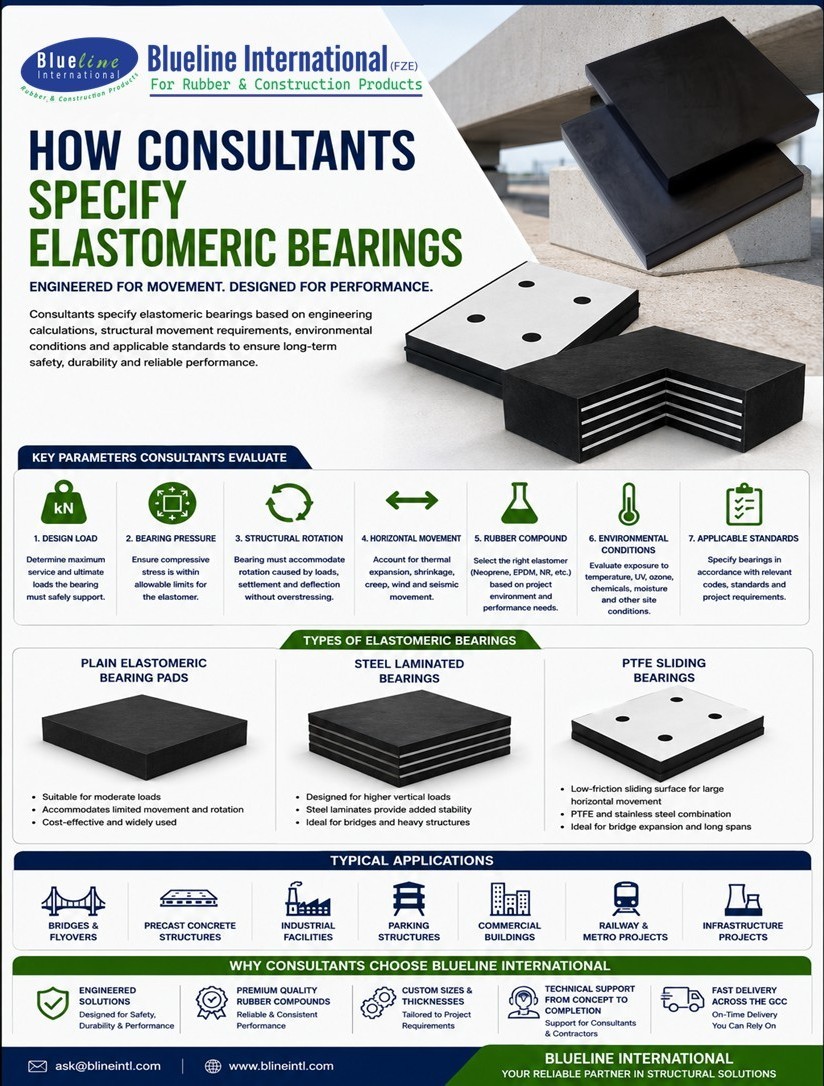
Key Parameters Consultants Evaluate
1. Design Load
The maximum service and ultimate loads determine the required bearing size, thickness, and load capacity.
2. Bearing Pressure
The bearing area must be adequate to keep compressive stresses within acceptable limits for the selected elastomer.
3. Structural Rotation
Bridge girders and precast members rotate under loading. The bearing must safely accommodate this rotation without overstressing the rubber.
4. Horizontal Movement
Consultants calculate movement caused by:
- Thermal expansion
- Concrete shrinkage
- Creep
- Wind loads
- Seismic effects (where applicable)
For larger movements, PTFE sliding bearings may be specified instead of plain elastomeric bearings.
5. Rubber Compound Selection
Material selection depends on the project environment and performance requirements.
Common options include:
- Neoprene (CR)
- Natural Rubber (NR)
- EPDM
- Other specialised elastomers for specific applications
6. Environmental Conditions
The bearing must perform reliably under the expected service conditions, including:
- Temperature variation
- UV exposure
- Moisture
- Ozone
- Chemicals (where applicable)
7. Applicable Standards
Consultants generally specify bearings in accordance with recognised project standards and client requirements, ensuring compliance with the applicable codes for structural bearing systems.
Types of Elastomeric Bearings
Depending on the project, consultants may specify:
Plain Elastomeric Bearing Pads
Suitable for moderate loads with limited movement.
Steel Laminated Bearings
Designed for higher vertical loads while maintaining flexibility and stability.
PTFE Sliding Bearings
Recommended for structures requiring significant horizontal movement with low-friction sliding.
Typical Applications
Elastomeric bearings are commonly used in:
- Highway Bridges
- Railway Bridges
- Flyovers
- Precast Concrete Buildings
- Parking Structures
- Industrial Plants
- Metro Projects
- Commercial Buildings
- Infrastructure Projects
- Water Treatment Facilities
Why Work with Blueline International?
Blueline International supplies engineered elastomeric bearing solutions for consultants, contractors, bridge builders, and precast manufacturers across the UAE and GCC.
Our product range includes:
- Plain Elastomeric Bearing Pads
- Steel Laminated Bearings
- PTFE Sliding Bearing Systems
- Custom Sizes and Thicknesses
- Technical Engineering Support
- High-Quality Rubber Compounds
- Fast Manufacturing and Delivery
Our team assists consultants in selecting bearing solutions that align with project-specific structural requirements.
Consultants specify elastomeric bearings based on engineering performance—not simply product dimensions. By evaluating load, movement, rotation, environmental conditions, and project standards, they ensure the selected bearing system contributes to the safety, durability, and long-term performance of the structure.
Partnering with an experienced manufacturer helps ensure that every bearing solution is engineered to meet the demands of the project.
For technical support or custom bearing solutions, contact Blueline International.
📧 ask@blineintl.com
🌐 www.blineintl.com
Frequently Asked Questions
How do consultants specify elastomeric bearings?
Consultants specify elastomeric bearings by evaluating structural loads, movement, rotation, compressive stress, environmental conditions, and compliance with project standards.
What factors affect bearing selection?
Key factors include load capacity, bearing pressure, rotation, horizontal movement, rubber compound, service environment, and structural design requirements.
When should PTFE sliding bearings be specified?
PTFE sliding bearings are typically selected when the structure must accommodate significant horizontal movement while supporting high vertical loads.
