
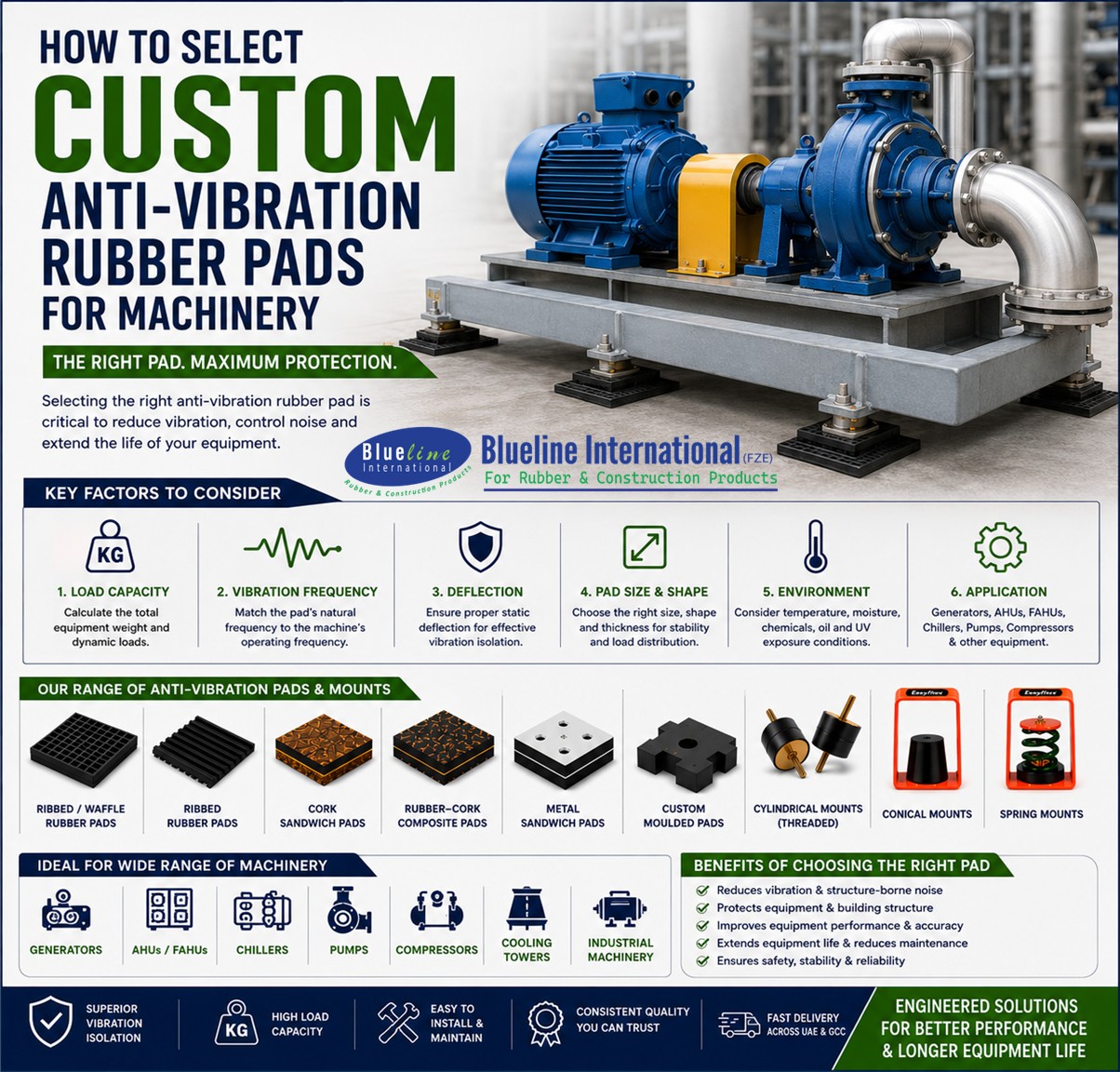
How to Select Custom Anti-Vibration Rubber Pads for Machinery
A custom anti-vibration rubber pad should not be designed from length, width and thickness alone.
The pad must safely support the machine while providing an appropriate response under its actual operating load. Blueline International provides customized anti-vibration pads and industrial rubber mounts for generators, HVAC equipment, pumps, compressors and heavy machinery in the UAE and Saudi Arabia.
When Is a Custom Anti-Vibration Pad Required?
A custom pad may be required when:
- Standard sizes do not match the equipment foot
- Equipment loads are unusually high
- Support reactions are unequal
- The mounting area is restricted
- A specific rubber grade is required
- Outdoor or chemical exposure must be considered
- Steel reinforcement is required
- Mounting holes or recesses are needed
- The installation uses an IPE beam or fabricated base
- A consultant has specified performance criteria
- Standard pads do not provide suitable deflection
Custom products may be molded, compression-molded, cut from sheet, laminated, reinforced or rubber-to-metal bonded.
Step 1: Determine the Operating Load
Use the complete operating weight—not only the dry shipping weight. Depending on the equipment, operating weight may include fluids, fuel, internal components and accessories.
Where loading is approximately equal:
Load per mount = total operating load ÷ number of mounts
If the manufacturer provides individual support reactions, use those values because they account for the equipment’s centre of gravity.
Step 2: Confirm the Effective Loaded Area
The effective area is the overlapping contact surface through which the load passes from the equipment into the rubber pad.
Bearing pressure = load per mount ÷ effective loaded area
For a pad installed under a narrow steel channel or IPE beam, the complete pad area may not be loaded. Increasing the pad’s unsupported outer dimensions does not necessarily increase its effective load capacity.
This consideration is particularly important for generator base frames, AHUs, chillers and fabricated machinery skids.
Step 3: Obtain Equipment Speed
Operating speed helps determine the vibration frequency:
Disturbing frequency in Hz = operating speed in RPM ÷ 60
A 1,500 RPM machine has a primary rotational frequency of 25 Hz. However, actual machinery may generate additional frequencies due to motors, compressors, fans, engine firing forces and connected equipment.
For critical applications, vibration-isolation design should be reviewed by a qualified engineer using complete dynamic information.
Step 4: Establish the Required Isolation
The natural frequency of the supported system must be sufficiently lower than the disturbing frequency to provide useful isolation.
Static deflection is therefore central to isolator selection. A rubber pad that barely compresses under the machine may provide less isolation than expected, even if its maximum load capacity is very high.
This explains why “higher capacity” does not automatically mean “better performance.”
Step 5: Select Rubber Hardness
Rubber hardness is commonly stated in Shore A. A harder compound can generally support greater pressure but normally deflects less under the same load and geometry.
A softer compound may provide more deflection but must remain stable and safely carry the imposed load.
Hardness should therefore be selected together with:
- Rubber polymer
- Pad area
- Pad thickness
- Shape factor
- Number of layers
- Required movement
- Environmental exposure
- Long-term compression behaviour
Step 6: Choose the Rubber Polymer
Natural Rubber
Natural rubber can provide excellent resilience and dynamic performance for suitable controlled environments. Its use should be assessed carefully where oil, ozone, UV or demanding outdoor exposure is expected.
Neoprene Rubber
Neoprene is widely used for HVAC, construction and industrial pads because it offers a practical combination of mechanical performance and environmental resistance.
EPDM Rubber
EPDM is particularly useful where resistance to weather, ozone, UV and water exposure is important. It is generally not selected for continuous petroleum-oil contact.
Nitrile Rubber
Nitrile rubber may be considered where oil and fuel resistance are important, subject to the complete application conditions.
SBR and Engineered Compounds
SBR and blended compounds can provide economical solutions for general industrial applications. The formulation must match the load, environment and required performance.
Step 7: Select the Pad Construction
The appropriate configuration may include:
- Plain solid rubber pad
- Waffle-pattern pad
- Ribbed rubber mounting pad
- Neoprene isolation pad
- Rubber-cork sandwich pad
- Metal sandwich anti-vibration pad
- Laminated reinforced rubber pad
- Rubber-to-metal bonded mount
- Cylindrical rubber mount
- Conical machine mount
- Custom molded machinery foot
Each construction has different behaviour and should not be selected solely on appearance.
Anti-Vibration Pad Load Capacity
A published pad capacity should be read together with the conditions under which it applies.
Before using a capacity value, confirm:
- Pad dimensions
- Effective loaded area
- Rubber hardness
- Permissible pressure
- Expected deflection
- Static or dynamic loading
- Safety factor
- Temperature
- Environmental exposure
- Duration of load
- Test method
The phrase “supports 1,000 kg” is incomplete unless the size, load distribution, material and performance criteria are known.
Blueline International provides engineered anti-vibration pads and custom-molded rubber mounts for effective heavy machinery vibration control and HVAC applications. Our technical support covers anti-vibration pad load capacity, anti-vibration pad selection, vibration isolation pad calculation, rubber pad pressure calculation, anti-vibration pad size selection, rubber pad static deflection, neoprene pad load capacity, and rubber pad dynamic stiffness. We also assist with vibration isolator selection for HVAC and provide an anti-vibration pad technical data sheet based on the required vibration isolation specification.
Blueline supports these requirements with application-based product recommendations.
Applications for Custom Rubber Pads
Our custom anti-vibration products can be considered for:
- Diesel generators
- Gensets
- AHUs and FAHUs
- Chillers
- Pumps
- Cooling towers
- Compressors
- Industrial fans
- Transformers
- Production machinery
- Printing machinery
- Rooftop equipment
- Data-centre equipment
- Heavy mechanical skids
Information to Send Blueline
For an engineered recommendation, provide:
- Equipment name and model
- Operating weight
- Number of support points
- Load at each support
- Equipment-foot dimensions
- Available pad dimensions
- Operating speed
- Indoor or outdoor location
- Exposure to oil, water, heat, ozone or chemicals
- Required isolation efficiency
- Relevant drawings and photographs
- Project location and quantity
Custom Anti-Vibration Pad Supplier in UAE and Saudi Arabia
Blueline International supplies custom anti-vibration rubber pads, heavy-duty machine mounts and vibration isolation products to contractors and industrial customers throughout the UAE and Saudi Arabia.
Contact us for technical review, product selection and quotation:
Email: ask@blineintl.com
Website: www.blineintl.com
Blueline International—engineered rubber pads and vibration isolation solutions developed around the equipment, load and application.
