
Myth vs Fact: Does a Thicker Anti-Vibration Pad Always Perform Better?
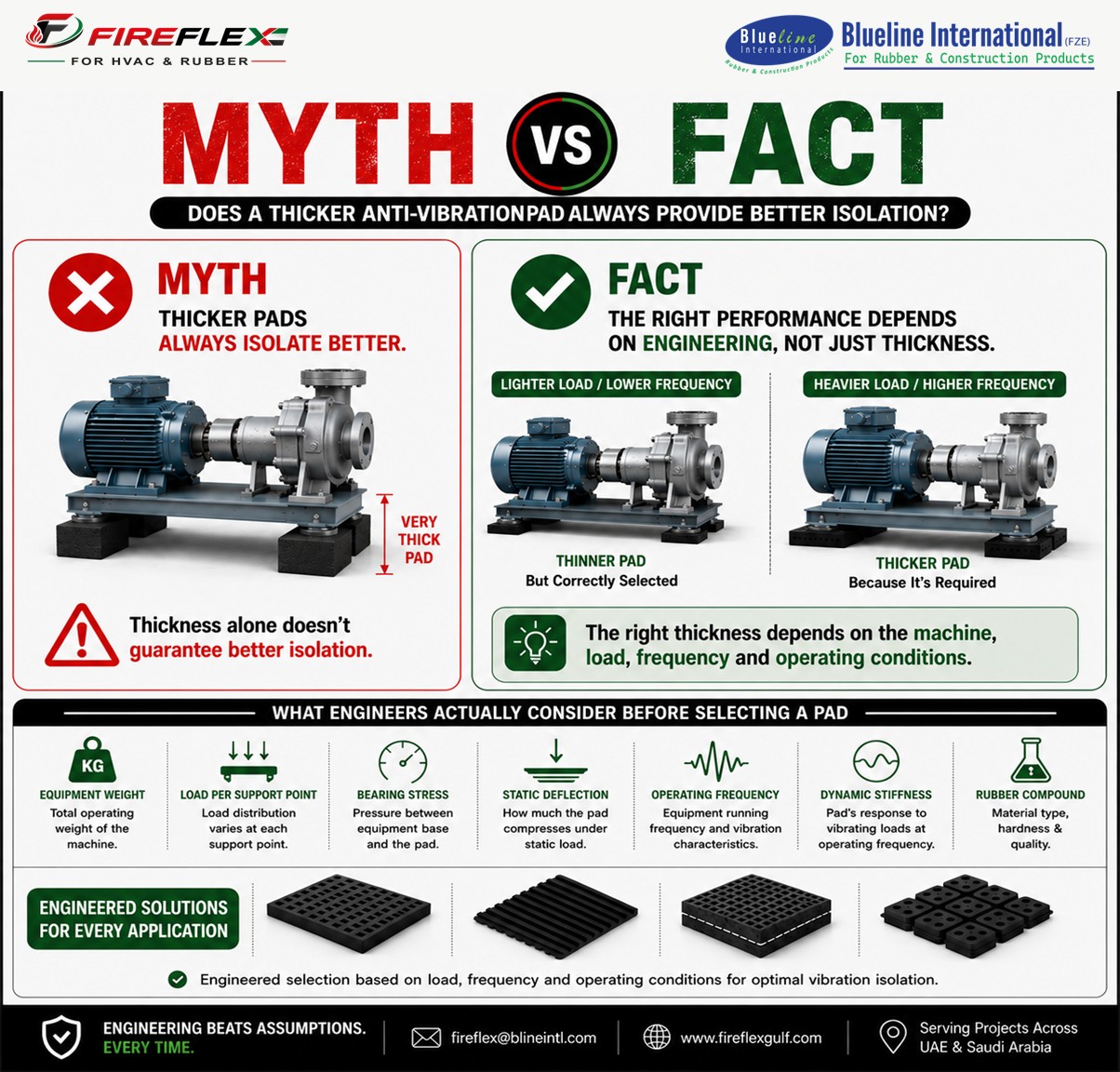
When selecting an anti-vibration pad, a common assumption is that more thickness automatically means better vibration isolation.
While thickness can influence performance, it is not the only factor that determines whether a pad will work effectively.
Engineers evaluate the complete operating conditions before recommending a vibration isolation solution.
MYTH
“The thicker the rubber pad, the better the vibration isolation.”
This belief often leads to oversized products being selected without considering the actual operating requirements.
FACT
A thicker pad does not automatically provide better vibration isolation.
The correct solution depends on several engineering factors working together.
These include:
- Equipment operating weight
- Load per support point
- Bearing stress
- Static deflection
- Operating frequency
- Dynamic stiffness
- Rubber compound
- Shore A hardness
- Environmental conditions
Selecting a pad based on thickness alone may not achieve the desired performance and can increase material cost unnecessarily.
Why Engineers Look Beyond Thickness
A properly selected anti-vibration pad is designed to suit the specific equipment and installation.
Rather than asking:
“How thick should the pad be?”
Engineers first ask:
- What is the equipment weight?
- How is the load distributed?
- What is the operating frequency?
- What level of vibration isolation is required?
Only after these questions are answered is the pad thickness determined as part of the overall design.
FireFlex Engineering Approach
FireFlex works with consultants, MEP contractors and project engineers to recommend vibration isolation solutions based on engineering data rather than a single product dimension.
Our technical team evaluates the application to help select a solution that supports equipment stability, reduced vibration transmission and long-term performance.
Planning an HVAC or Industrial Project?
Need help selecting the right anti-vibration pad?
FireFlex can assist with engineering-based product selection for chillers, AHUs, pumps, generators, cooling towers and other mechanical equipment.
Frequently Asked Questions
Does increasing pad thickness always improve vibration isolation?
No. Thickness is only one design parameter. Performance also depends on load, operating frequency, static deflection, dynamic stiffness and other engineering factors.
How is the correct pad thickness selected?
Engineers determine the required thickness after evaluating equipment load, support conditions and vibration isolation requirements.
Can a thinner pad perform better?
Yes. If it is correctly selected for the application, a thinner pad may perform better than a thicker pad that is not matched to the equipment.
