
Bearing Pad Selection Guide: How to Choose the Right Elastomeric Bearing Pad
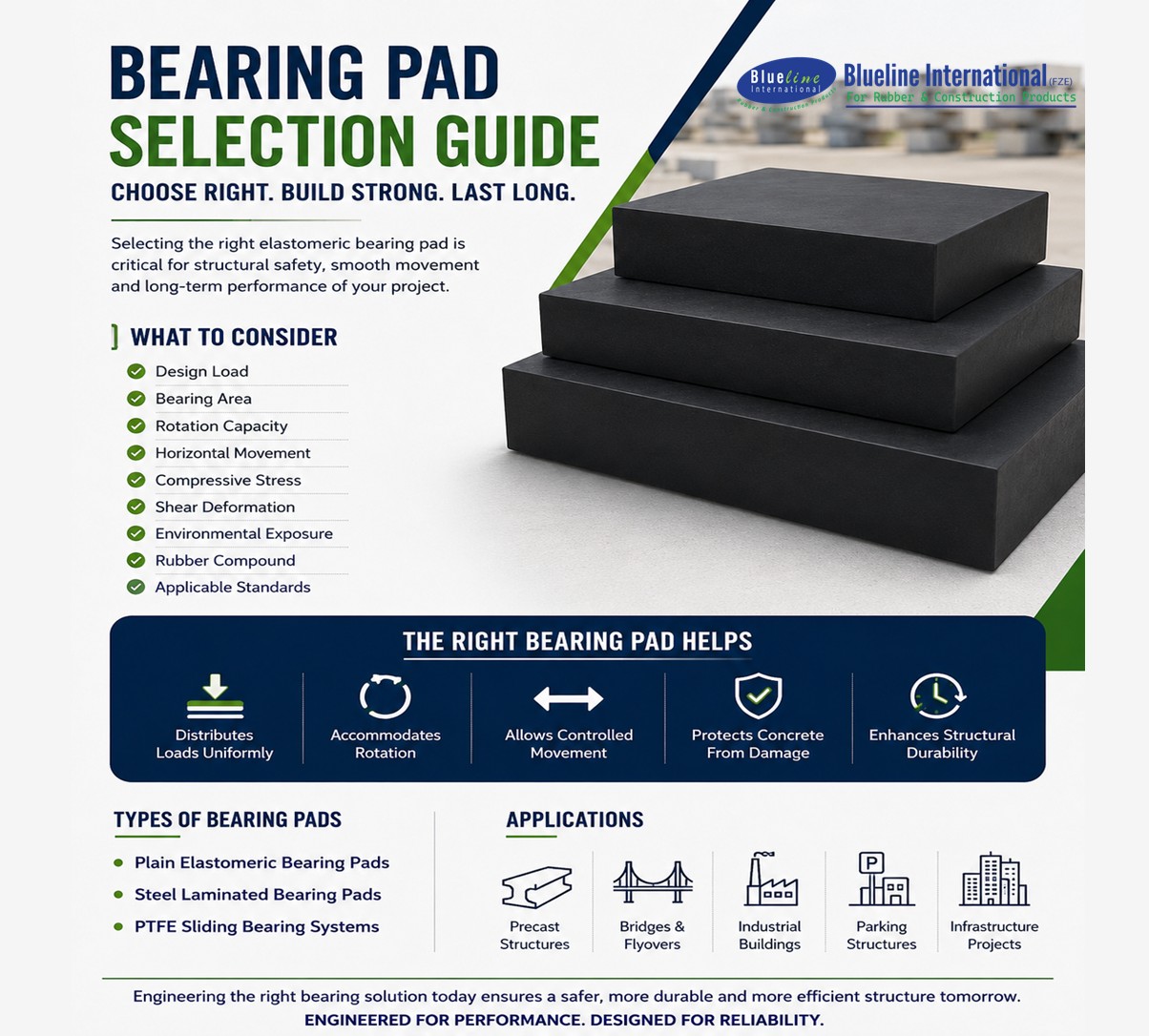
Selecting the correct elastomeric bearing pad is one of the most important decisions in structural design. Whether you’re working on a bridge, precast concrete structure, industrial facility, or commercial building, the bearing pad must safely transfer loads while accommodating movement and protecting structural elements throughout the service life of the project.
A bearing pad should never be selected based solely on dimensions or price. Proper selection requires an engineering evaluation of structural loads, movement, environmental conditions, and project specifications.
Why Bearing Pad Selection Is Critical
Elastomeric bearing pads serve as the interface between structural components. Their primary function is to distribute loads evenly while allowing controlled deformation that accommodates movement and rotation.
A correctly selected bearing pad helps:
- Distribute vertical loads uniformly
- Reduce stress concentrations
- Accommodate structural rotation
- Allow controlled horizontal movement
- Protect concrete edges from cracking and spalling
- Compensate for minor construction tolerances
- Improve the long-term durability of the structure
Incorrect selection can lead to excessive deformation, localized stresses, premature wear, and increased maintenance costs.
Key Factors to Consider When Selecting a Bearing Pad
1. Design Load
The first step is determining the maximum vertical load the bearing pad must support. This influences the required bearing area, thickness, and material characteristics.
2. Bearing Area
The bearing area should be sufficient to distribute compressive forces without exceeding the allowable stress limits of the elastomer.
3. Structural Rotation
Bridges and precast structures often experience rotation due to loading, deflection, and settlement. The bearing pad must accommodate this rotation without overstressing the rubber.
4. Horizontal Movement
Thermal expansion, contraction, creep, and shrinkage can cause structural movement. Depending on the expected displacement, engineers may specify plain elastomeric pads or PTFE sliding bearing systems.
5. Compressive Stress
The selected bearing pad should maintain acceptable compressive stress levels while ensuring reliable long-term performance.
6. Shear Deformation
Where lateral movement is expected, the bearing pad must safely accommodate shear deformation without compromising structural stability.
7. Environmental Conditions
Exposure to UV radiation, moisture, chemicals, oils, ozone, or extreme temperatures should be considered when selecting the appropriate elastomer compound.
8. Rubber Compound
The rubber material significantly influences performance. Common elastomer options include:
- Neoprene (CR)
- Natural Rubber (NR)
- EPDM
- Nitrile Rubber (NBR) for specific industrial environments
Material selection should be based on project requirements rather than cost alone.
Types of Bearing Pads
Depending on the structural application, consultants may select:
Plain Elastomeric Bearing Pads
Suitable for moderate loads with limited movement.
Steel Laminated Bearing Pads
Designed for higher vertical loads while maintaining controlled flexibility.
PTFE Sliding Bearing Systems
Ideal for structures requiring larger horizontal movement with low-friction sliding.
Typical Applications
Blueline bearing pads are widely used in:
- Precast Concrete Buildings
- Bridge Structures
- Flyovers
- Industrial Facilities
- Parking Structures
- Commercial Buildings
- Infrastructure Projects
- Water Treatment Plants
- Metro & Railway Projects
- Utility Structures
Why Choose Blueline International?
Blueline International manufactures engineered elastomeric bearing solutions for consultants, contractors, bridge builders, and precast manufacturers throughout the UAE, Saudi Arabia, and the GCC.
Our capabilities include:
- Plain Elastomeric Bearing Pads
- Steel Laminated Bearing Pads
- PTFE Sliding Bearing Systems
- Custom Sizes & Thicknesses
- Engineering Support
- Premium Rubber Compounds
- Quality-Controlled Manufacturing
- Fast GCC Delivery
Our technical team assists consultants in selecting the most appropriate bearing solution for every project.
Choosing the correct bearing pad requires more than selecting a standard rubber block. Proper engineering evaluation of load, movement, rotation, environmental exposure, and material properties is essential for ensuring structural safety and long-term performance.
By working with an experienced manufacturer, consultants and contractors can specify bearing systems that deliver dependable performance throughout the life of the structure.
For technical assistance or custom bearing pad solutions, contact Blueline International.
📧 ask@blineintl.com
🌐 www.blineintl.com
Frequently Asked Questions
How do you select the correct bearing pad?
The correct bearing pad is selected by evaluating design load, bearing area, structural rotation, horizontal movement, compressive stress, shear deformation, environmental exposure, and project specifications.
What is the purpose of an elastomeric bearing pad?
An elastomeric bearing pad distributes structural loads, accommodates movement and rotation, reduces stress concentrations, and protects concrete elements.
When should a PTFE sliding bearing be used?
PTFE sliding bearings are used when significant horizontal movement is expected and low-friction movement is required.
What is the difference between plain and steel laminated bearing pads?
Plain bearing pads are suitable for moderate loads, while steel laminated bearing pads are designed for higher vertical loads and improved dimensional stability.
