
Bearing Pads for Precast Concrete – Why They Are Essential for Structural Performance
Precast concrete construction has become one of the most preferred building methods due to its speed, quality, and efficiency. However, the long-term performance of precast structures depends not only on the concrete elements themselves but also on the components installed between them. One of the most important of these components is the elastomeric bearing pad.
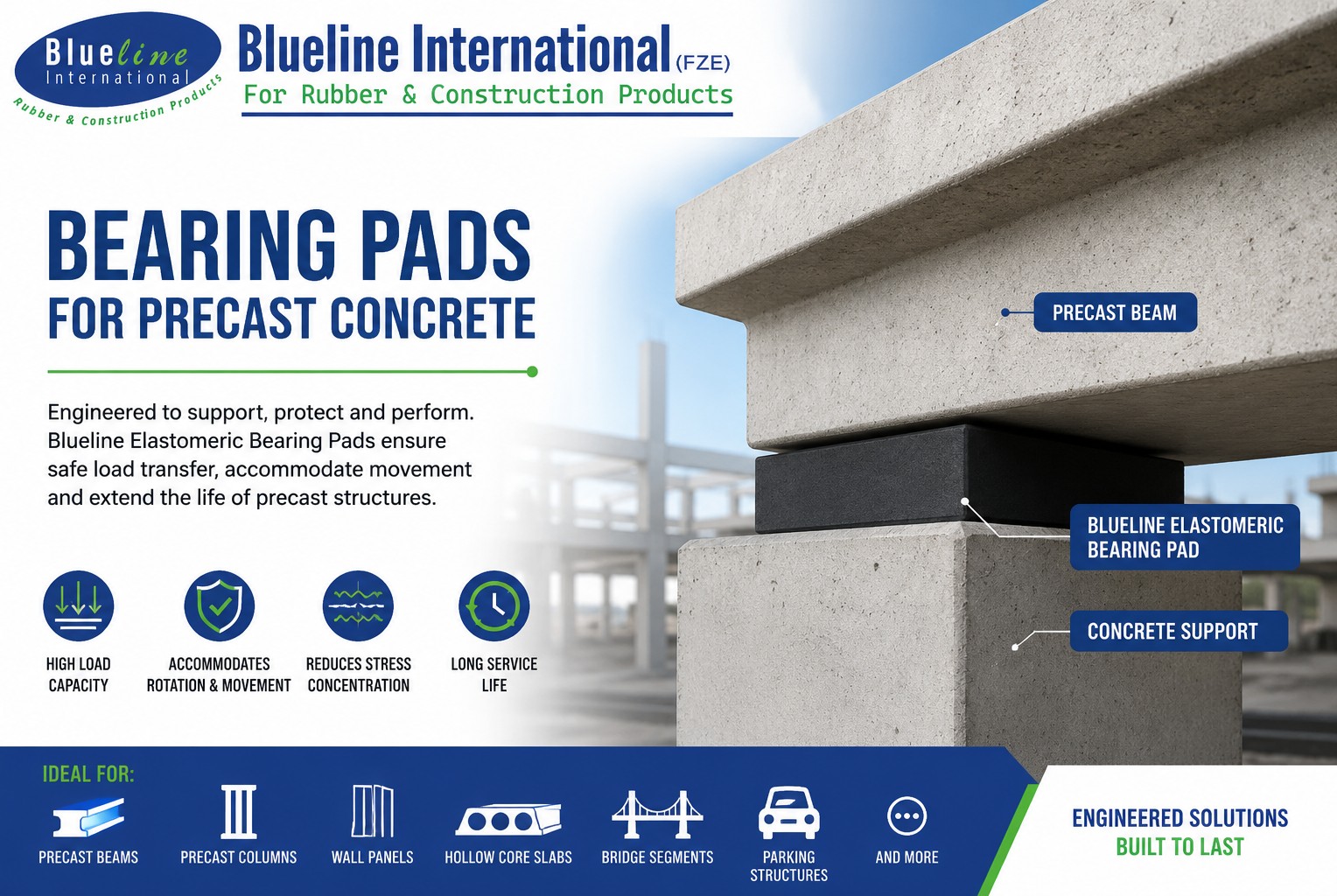
Bearing pads provide a flexible interface between precast concrete elements, helping distribute loads evenly while accommodating small movements, rotation, and differential settlement. Without properly selected bearing pads, concentrated stresses can develop at contact points, increasing the risk of cracking, edge spalling, and premature structural deterioration.
Why Bearing Pads Are Used in Precast Concrete
Bearing pads are installed between structural members to:
- Distribute compressive loads uniformly
- Reduce stress concentrations
- Accommodate structural rotation
- Allow controlled horizontal movement where required
- Minimize concrete-to-concrete contact
- Reduce vibration transmission
- Protect structural edges during service
These functions improve the durability and reliability of precast structures throughout their service life.
Typical Applications
Blueline bearing pads are suitable for:
- Precast beams
- Precast columns
- Hollow core slabs
- Double tee beams
- Wall panels
- Staircase landings
- Bridge precast segments
- Industrial precast buildings
- Parking structures
- Infrastructure projects
Types of Bearing Pads
Depending on the project requirements, engineers may specify:
Plain Elastomeric Bearing Pads
Suitable for applications with moderate loads and limited movement.
Steel Laminated Elastomeric Bearing Pads
Designed for higher vertical loads while controlling deformation.
PTFE Sliding Bearing Pads
Used where larger horizontal movement must be accommodated while maintaining low friction.
Material Selection Matters
Selecting the correct rubber compound is critical for long-term performance. Depending on environmental exposure and project requirements, bearing pads may be manufactured using different elastomer compounds and hardness grades.
Proper engineering selection should always consider:
- Vertical design load
- Rotation
- Horizontal movement
- Bearing area
- Temperature conditions
- Environmental exposure
- Applicable project specifications
Why Choose Blueline International?
Blueline International manufactures high-quality elastomeric bearing pads for construction and infrastructure projects across the UAE and GCC.
Our capabilities include:
- Plain bearing pads
- Laminated elastomeric bearings
- PTFE sliding bearings
- Custom dimensions
- Multiple hardness options
- Engineering support
- Fast manufacturing
- Consistent quality control
Whether your project involves commercial buildings, bridges, precast factories, or infrastructure developments, our technical team can assist in selecting the appropriate bearing solution.
Bearing pads may appear to be a small component within a precast structure, but they play a significant role in protecting structural elements, improving load transfer, and extending service life. Selecting the appropriate bearing pad helps reduce maintenance requirements and contributes to safer, more durable construction.
For technical assistance or custom bearing pad solutions, contact Blueline International to discuss your project requirements.
