
How Noise Travels Through Buildings: Understanding Structure-Borne Vibration
When people think about noise inside a building, they usually imagine sound travelling through the air.
While airborne noise is important, many noise complaints in commercial buildings actually originate from structure-borne vibration.
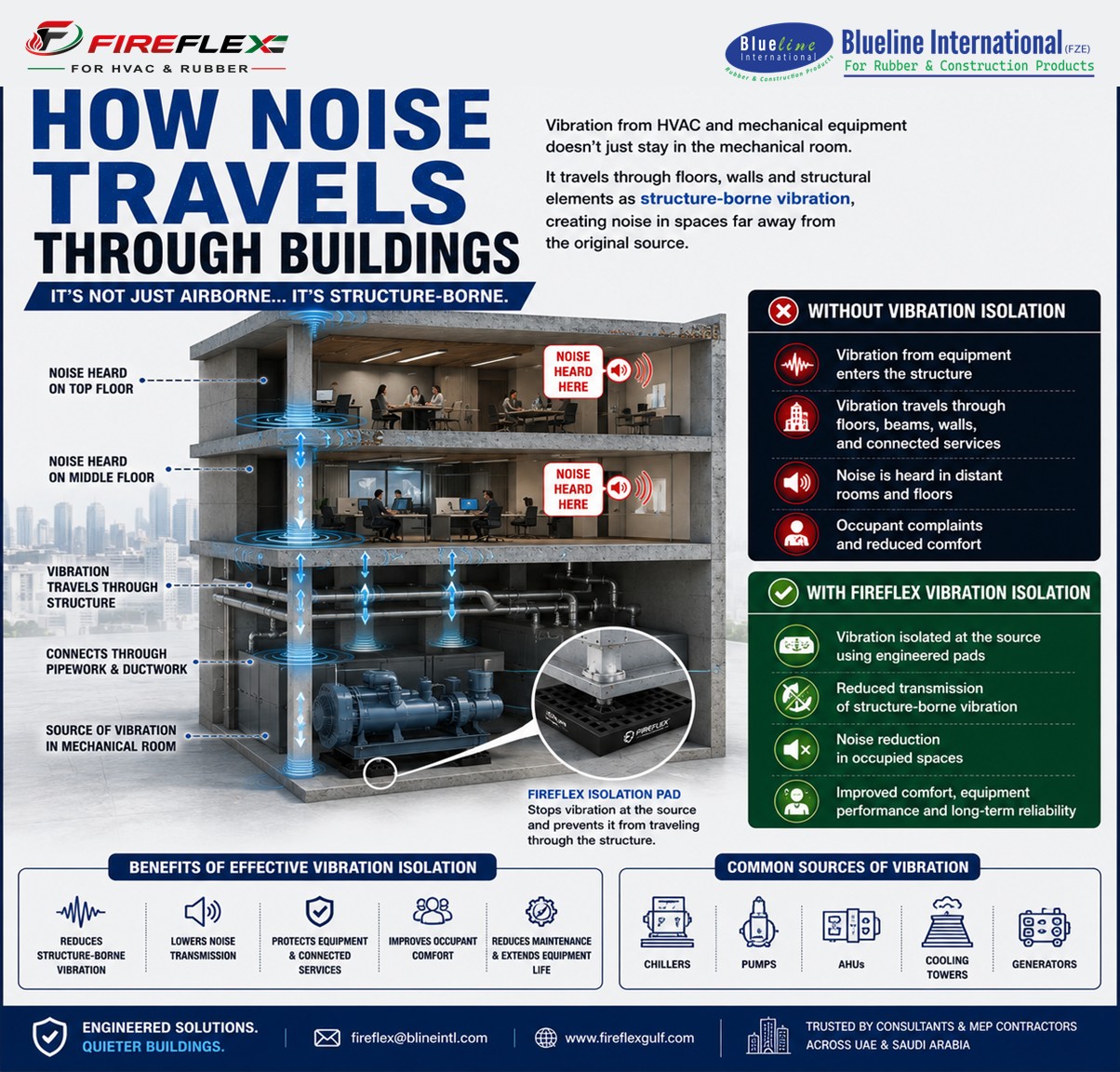
This type of vibration can travel through floors, beams, columns and connected services, allowing noise to be perceived far from the original equipment.
Understanding how vibration moves through a building is essential when designing HVAC and mechanical systems.
Airborne Noise vs Structure-Borne Noise
Airborne Noise
Airborne noise travels through the air before reaching the listener.
Examples include:
- Conversations
- Music
- Fans
- Loudspeakers
Structure-Borne Noise
Structure-borne noise begins as vibration.
Mechanical equipment transfers vibration into the building structure, where it travels through:
- Concrete slabs
- Steel frames
- Pipe supports
- Duct supports
- Mechanical bases
These vibrations may then be heard as noise in distant rooms.
Common Sources of Building Vibration
Typical equipment includes:
- Chillers
- Cooling Towers
- Pumps
- Air Handling Units
- CRAC Units
- CRAH Units
- Compressors
- Standby Generators
Without proper vibration isolation, these systems may transmit vibration throughout the building.
Why Consultants Consider Vibration Isolation
Proper vibration isolation helps:
- Reduce structure-borne vibration
- Improve acoustic comfort
- Protect mechanical equipment
- Improve occupant satisfaction
- Reduce stress on connected services
- Support long-term system reliability
For hospitals, hotels, offices, data centres and residential towers, vibration control is often considered during the design stage to improve overall building performance.
FireFlex Vibration Isolation Solutions
FireFlex supplies engineered vibration isolation products for HVAC and mechanical equipment, including:
- Waffle Anti-Vibration Pads
- Ribbed Rubber Pads
- Metal Sandwich Pads
- Cork Sandwich Pads
- Anti-Vibration Mounts
Our technical team assists consultants and contractors in selecting solutions based on equipment load, operating conditions and project requirements.
Typical Applications
- Commercial Buildings
- Hospitals
- Hotels
- Data Centres
- Airports
- Industrial Facilities
- Residential Towers
- Manufacturing Plants
Why Choose FireFlex?
FireFlex works with consultants, architects, MEP contractors and developers across the UAE and Saudi Arabia to provide engineered vibration isolation solutions that support quieter, more reliable buildings.
Call to Action
Planning an HVAC Project?
Our engineering team can assist with selecting vibration isolation solutions that help reduce structure-borne vibration and improve building performance.
Frequently Asked Questions
What is structure-borne noise?
Structure-borne noise occurs when vibration from mechanical equipment travels through the building structure and is perceived as sound in other areas.
Can anti-vibration pads reduce building noise?
Properly selected anti-vibration pads help reduce the transfer of vibration into the building structure, contributing to lower structure-borne noise.
Which equipment benefits from vibration isolation?
Chillers, pumps, cooling towers, AHUs, CRAC units, CRAH units, compressors and standby generators commonly benefit from engineered vibration isolation.
