
Rubber Pads vs Spring Isolators: Which Vibration Isolation Solution Is Right?
Selecting the correct vibration isolation solution is an important part of HVAC and mechanical system design.
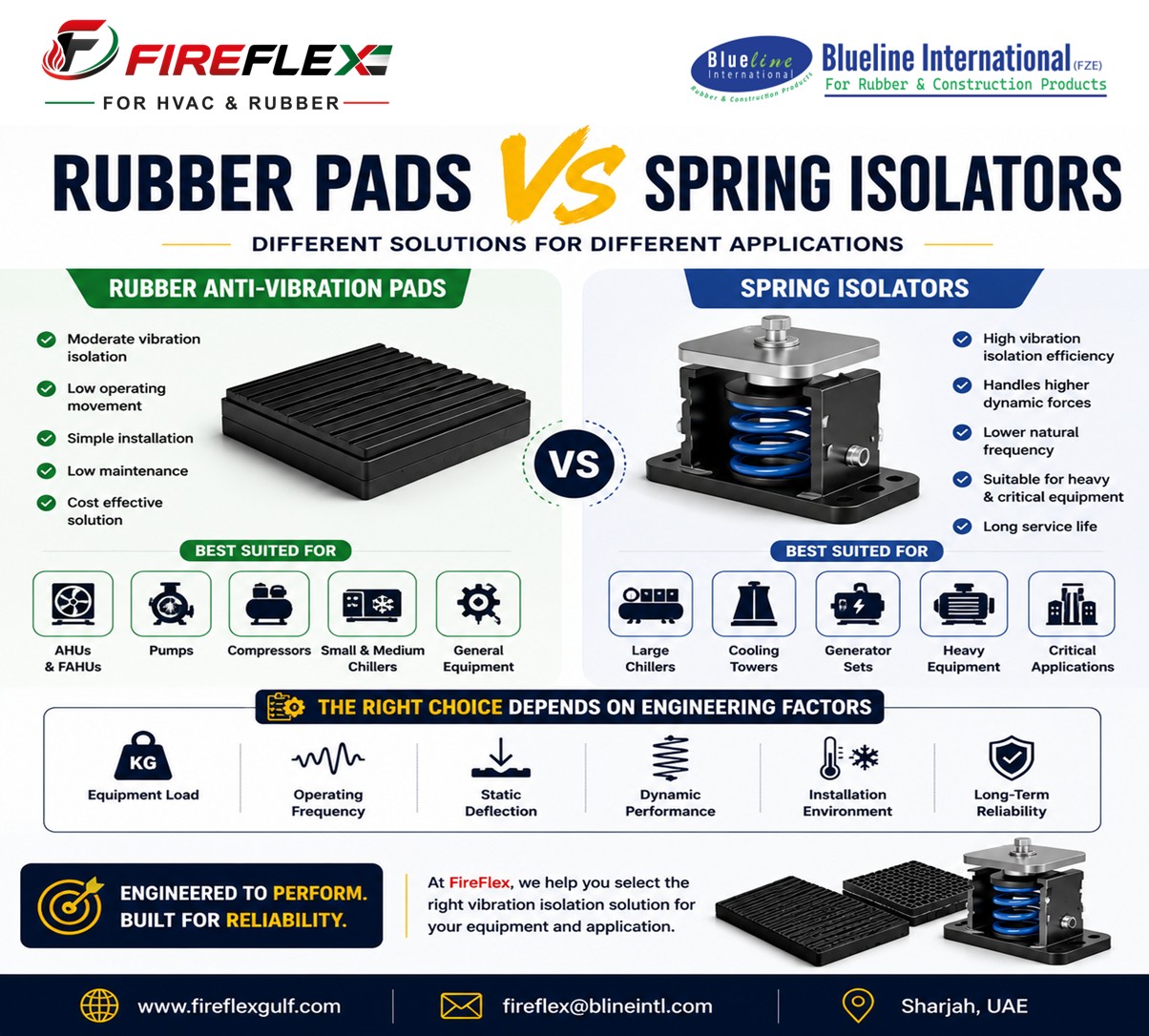
Among the most common options are rubber anti-vibration pads and spring isolators. While both help reduce vibration transmission, they are designed for different operating conditions and equipment requirements.
Understanding their characteristics can help improve equipment reliability and long-term performance.
What Are Rubber Anti-Vibration Pads?
Rubber anti-vibration pads provide vibration isolation through the elastic properties of engineered rubber compounds.
They are commonly used where moderate vibration isolation, ease of installation, and minimal maintenance are important.
Typical applications include:
- Air Handling Units (AHUs)
- Fresh Air Handling Units (FAHUs)
- Pumps
- Compressors
- Small and medium chillers
- Mechanical equipment
What Are Spring Isolators?
Spring isolators reduce vibration using specially designed steel springs.
They are generally selected for equipment that generates greater dynamic forces or where higher vibration isolation performance is required.
Typical applications include:
- Large chillers
- Cooling towers
- Generator sets
- Heavy mechanical equipment
- High-capacity HVAC systems
Which One Should You Choose?
Neither solution is universally better.
Selection depends on several engineering considerations, including:
- Equipment load
- Operating frequency
- Required static deflection
- Dynamic forces
- Installation environment
- Desired vibration isolation performance
Choosing the appropriate isolation system helps improve equipment protection, reduce maintenance, and support long-term reliability.
FireFlex Engineering Approach
FireFlex provides engineered vibration isolation solutions for a wide range of HVAC and mechanical applications.
Our technical team assists in selecting the appropriate solution based on equipment operating conditions and project requirements.
FAQ
Are rubber pads better than spring isolators?
Neither is inherently better. Each is suited to different equipment and vibration isolation requirements.
When are spring isolators typically used?
Spring isolators are commonly used for larger equipment or applications requiring higher vibration isolation performance.
Can rubber pads be used under chillers?
Yes. Rubber anti-vibration pads are commonly used beneath many chillers when selected according to the equipment load and vibration isolation requirements.
