
Understanding Dynamic Stiffness in Anti-Vibration Pads
When specifying anti-vibration pads, many engineers focus on rubber hardness (Shore A) because it is commonly listed on product data sheets.
However, hardness alone does not fully describe how a vibration isolation material behaves during operation.
One of the most important—but often overlooked—properties is dynamic stiffness.
Understanding this characteristic can help consultants and MEP engineers make more informed decisions when selecting vibration isolation products for HVAC and mechanical equipment.
What Is Dynamic Stiffness?
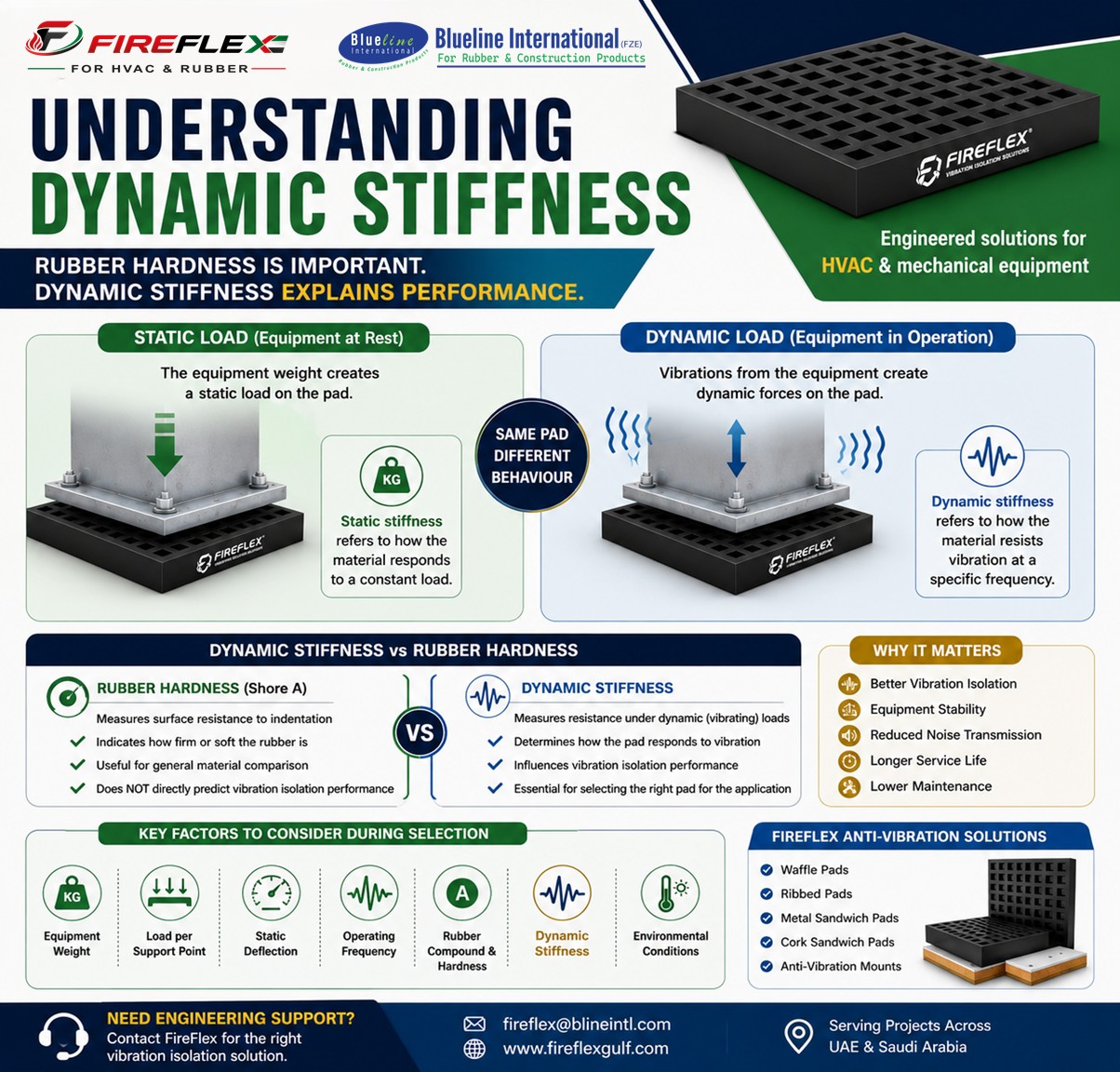
Dynamic stiffness describes how resistant a material is to deformation when subjected to repeated or vibrating loads.
Unlike static loading, mechanical equipment such as chillers, pumps, cooling towers and generators continuously generate dynamic forces while operating.
The way an anti-vibration pad responds to these forces influences its vibration isolation performance.
Dynamic Stiffness vs Rubber Hardness
These properties are related but not identical.
Rubber Hardness (Shore A)
- Indicates surface resistance to indentation.
- Useful for comparing general material firmness.
- Does not directly predict vibration isolation performance.
Dynamic Stiffness
- Describes the material’s behaviour under dynamic loading.
- Influences vibration transmission.
- Helps determine how effectively vibration energy is isolated.
A material with the same Shore A hardness can have different dynamic stiffness characteristics depending on its formulation and construction.
Why Dynamic Stiffness Matters
Considering dynamic stiffness during product selection can help support:
- Improved vibration isolation
- Better equipment stability
- Reduced structure-borne vibration
- Lower noise transmission
- More reliable long-term performance
The most suitable vibration isolation solution depends on balancing dynamic stiffness with other engineering parameters.
Engineering Factors That Should Be Considered
When selecting an anti-vibration pad, engineers should evaluate:
- Equipment operating weight
- Load per support point
- Bearing pressure
- Static deflection
- Operating frequency
- Rubber compound
- Dynamic stiffness
- Environmental conditions
Looking at these factors together helps ensure that the selected product is appropriate for the application.
Applications
Dynamic stiffness is an important consideration for vibration isolation of:
- Chillers
- Air Handling Units (AHUs)
- CRAH Units
- CRAC Units
- Pumps
- Cooling Towers
- Standby Generators
- Rooftop Mechanical Equipment
Why FireFlex?
FireFlex supports consultants, MEP contractors and project engineers by helping evaluate vibration isolation requirements based on engineering principles rather than a single material property.
Our goal is to recommend solutions that match the operating conditions of the equipment and contribute to long-term system reliability.
Call to Action
Need Help Selecting the Right Anti-Vibration Pad?
Our engineering team can help review your equipment data and recommend a vibration isolation solution based on load, operating conditions and project requirements.
Frequently Asked Questions
Is dynamic stiffness the same as rubber hardness?
No. Rubber hardness measures resistance to indentation, while dynamic stiffness describes how a material responds to repeated or vibrating loads.
Why is dynamic stiffness important?
It influences how effectively an anti-vibration pad responds to operating vibrations and is one of several factors considered when selecting a vibration isolation solution.
Should dynamic stiffness be considered for all HVAC equipment?
It is an important engineering consideration for vibration isolation systems used with chillers, pumps, generators, cooling towers, AHUs and other mechanical equipment.
