

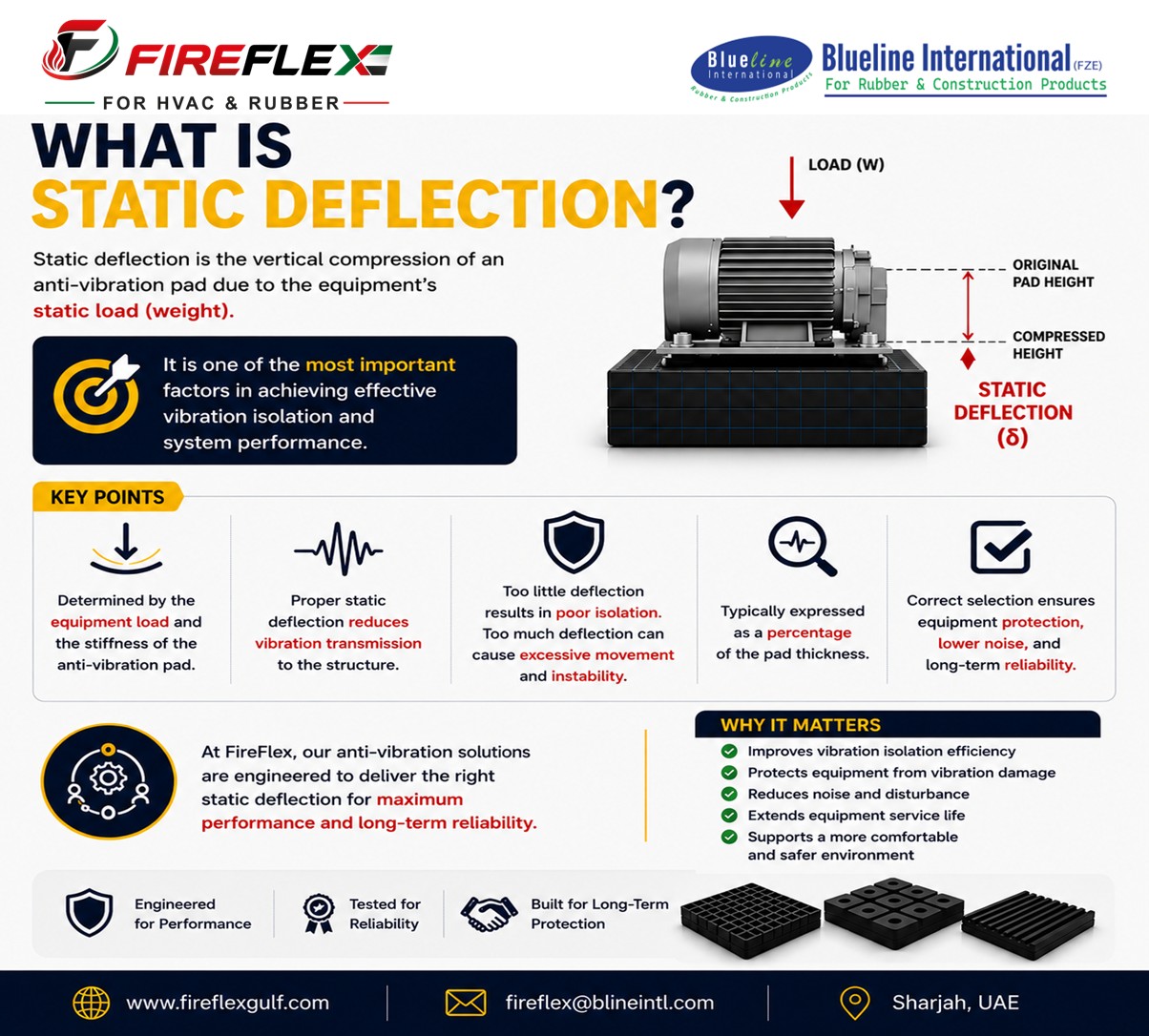
What Is Static Deflection?
When engineers select an anti-vibration pad, one of the most important parameters they consider is static deflection.
Although the term sounds technical, the concept is straightforward.
Static deflection is the amount an anti-vibration pad compresses under the static weight of the equipment it supports.
In simple terms, it measures how much the pad compresses once the equipment is placed on it and before it begins operating.
Understanding static deflection is essential because it directly influences the effectiveness of vibration isolation.
Why Is Static Deflection Important?
Static deflection plays a significant role in determining how efficiently an anti-vibration pad reduces vibration transmission.
A properly selected pad helps to:
- Reduce vibration transferred into the building structure
- Lower structure-borne noise
- Improve equipment stability
- Protect mechanical equipment
- Extend the service life of both the equipment and the isolation system
Because every piece of equipment is different, the required static deflection also varies depending on the application.
What Influences Static Deflection?
Several engineering factors affect static deflection, including:
- Equipment weight (static load)
- Rubber compound properties
- Pad thickness
- Pad surface area
- Material stiffness
- Load distribution
These factors work together to determine how much the pad compresses under load.
Can Too Much or Too Little Deflection Be a Problem?
Yes.
A pad with too little static deflection may not provide effective vibration isolation, allowing vibration and noise to transfer into the supporting structure.
On the other hand, excessive static deflection may result in unnecessary equipment movement, reduced stability, or increased maintenance requirements.
The objective is to select a pad that provides the appropriate amount of deflection for the specific equipment and operating conditions.
Static Deflection Is Only One Part of the Design
While static deflection is important, it should never be considered on its own.
A complete engineering evaluation should also consider:
- Equipment load
- Operating frequency
- Dynamic forces
- Rubber compound
- Hardness (Shore A)
- Installation conditions
- Environmental exposure
Selecting an anti-vibration pad involves balancing all of these factors to achieve reliable vibration isolation.
FireFlex Engineering Approach
At FireFlex, anti-vibration pads are selected based on engineering principles rather than appearance or dimensions alone.
Our technical team evaluates equipment characteristics and operating conditions to recommend vibration isolation solutions that help improve performance, reduce maintenance, and support long-term reliability.
Whether the application involves chillers, AHUs, FAHUs, pumps, compressors, cooling towers, or generators, proper engineering selection remains the foundation of effective vibration isolation.
Frequently Asked Questions
What is static deflection?
Static deflection is the amount an anti-vibration pad compresses under the constant weight of the supported equipment.
Why is static deflection important?
It influences vibration isolation performance, equipment stability, noise reduction, and long-term reliability.
Does greater static deflection always provide better vibration isolation?
Not necessarily. The appropriate amount of static deflection depends on the equipment, operating conditions, and engineering requirements.
What affects static deflection?
Equipment weight, pad thickness, rubber compound, stiffness, contact area, and load distribution all influence static deflection.
Which equipment uses anti-vibration pads with static deflection considerations?
Chillers, AHUs, FAHUs, pumps, compressors, cooling towers, generators, fans, and many other HVAC and mechanical systems.
