

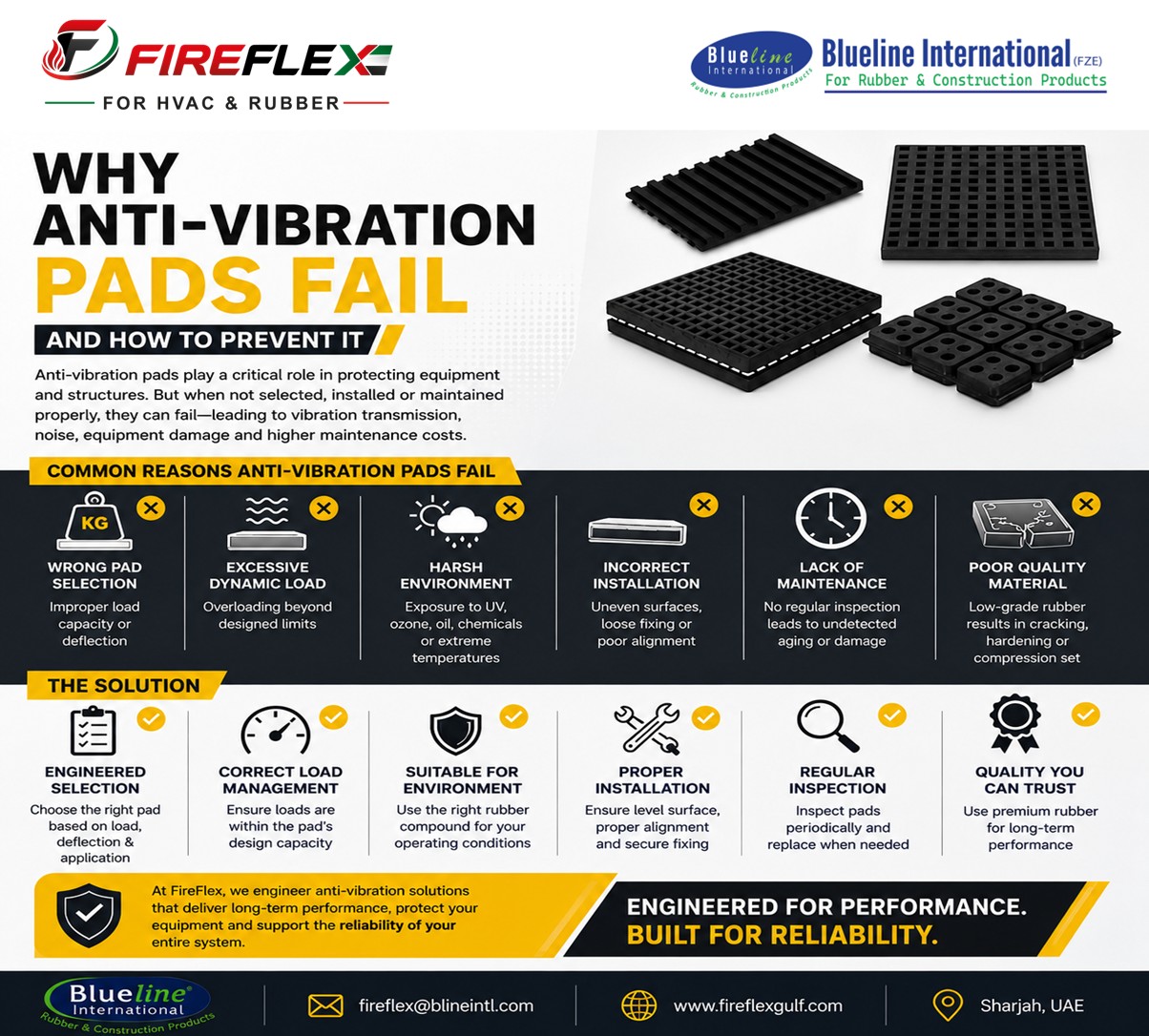
Why Anti-Vibration Pads Fail: Common Causes and How to Prevent Them
Anti-vibration pads are among the smallest components in an HVAC installation, yet they have a significant influence on equipment performance, vibration control and long-term reliability.
When properly selected and installed, anti-vibration pads help reduce vibration transmission, minimize structure-borne noise and protect both equipment and building structures.
However, failures can occur when the wrong product is selected or when installation and operating conditions are not properly considered.
Below are some of the most common reasons anti-vibration pads fail.
1. Incorrect Pad Selection
Every HVAC system has different operating loads.
Selecting a pad based only on its dimensions or appearance may result in excessive compression or insufficient vibration isolation.
Proper selection should always consider:
- Equipment weight
- Load distribution
- Static deflection
- Operating frequency
- Required isolation efficiency
2. Excessive Dynamic Loading
Equipment such as chillers, pumps and compressors generate dynamic forces during operation.
If these forces exceed the pad’s design capability, premature wear and reduced isolation performance may occur.
3. Unsuitable Environmental Conditions
Operating environments can significantly influence rubber performance.
Exposure to:
- UV radiation
- Ozone
- Oil
- Chemicals
- High temperatures
- Outdoor weather
may affect long-term durability if an unsuitable rubber compound is selected.
Choosing the appropriate material for the environment is just as important as selecting the correct pad design.
4. Improper Installation
Even a high-quality anti-vibration pad cannot perform as intended if it is installed incorrectly.
Common installation issues include:
- Uneven support surfaces
- Incorrect positioning
- Misalignment
- Poor load distribution
- Improper fixing arrangements
Proper installation helps ensure consistent vibration isolation throughout the equipment’s service life.
5. Lack of Inspection and Maintenance
Like any engineered component, vibration isolation systems benefit from periodic inspection.
Routine checks can help identify:
- Permanent compression
- Cracking
- Ageing
- Misalignment
- Physical damage
Early detection helps prevent larger maintenance issues.
6. Poor Material Quality
Not all rubber products are designed for vibration isolation.
A properly engineered anti-vibration pad is manufactured using suitable rubber compounds and designed to perform under specific loading and operating conditions.
Selecting products based only on price may affect long-term equipment performance and maintenance costs.
Why Engineering Selection Matters
An anti-vibration pad is not simply a piece of rubber.
Its performance depends on several engineering factors including:
- Equipment load
- Static deflection
- Dynamic stiffness
- Natural frequency
- Rubber compound
- Environmental conditions
- Installation quality
The correct combination of these factors helps achieve reliable vibration isolation and long-term equipment protection.
FireFlex Anti-Vibration Solutions
FireFlex provides engineered anti-vibration solutions for a wide range of HVAC and mechanical equipment, including:
- Chillers
- Air Handling Units (AHUs)
- Fresh Air Handling Units (FAHUs)
- Pumps
- Compressors
- Cooling Towers
- Generators
- Fans
- Mechanical Equipment
Our technical team can assist in selecting the appropriate anti-vibration pad based on equipment load and operating requirements.
Why do anti-vibration pads fail?
Common causes include incorrect selection, excessive loading, poor installation, unsuitable environmental conditions, lack of maintenance and low-quality materials.
Do all rubber pads provide vibration isolation?
No. Anti-vibration pads are engineered products selected according to equipment load, operating conditions and vibration isolation requirements.
Can anti-vibration pad failure increase equipment vibration?
Yes. An unsuitable or deteriorated anti-vibration pad may reduce isolation performance, potentially allowing more vibration to be transmitted to the supporting structure.
How often should anti-vibration pads be inspected?
Inspection intervals depend on the operating environment and equipment duty. Periodic visual inspections are generally recommended as part of routine maintenance programs.
Which HVAC equipment commonly uses anti-vibration pads?
Chillers, AHUs, FAHUs, pumps, compressors, cooling towers, generators and other mechanical equipment commonly use vibration isolation pads.
