
Why Engineers Calculate Bearing Stress Before Selecting an Anti-Vibration Pad
Selecting an anti-vibration pad involves much more than matching the pad to the equipment footprint.
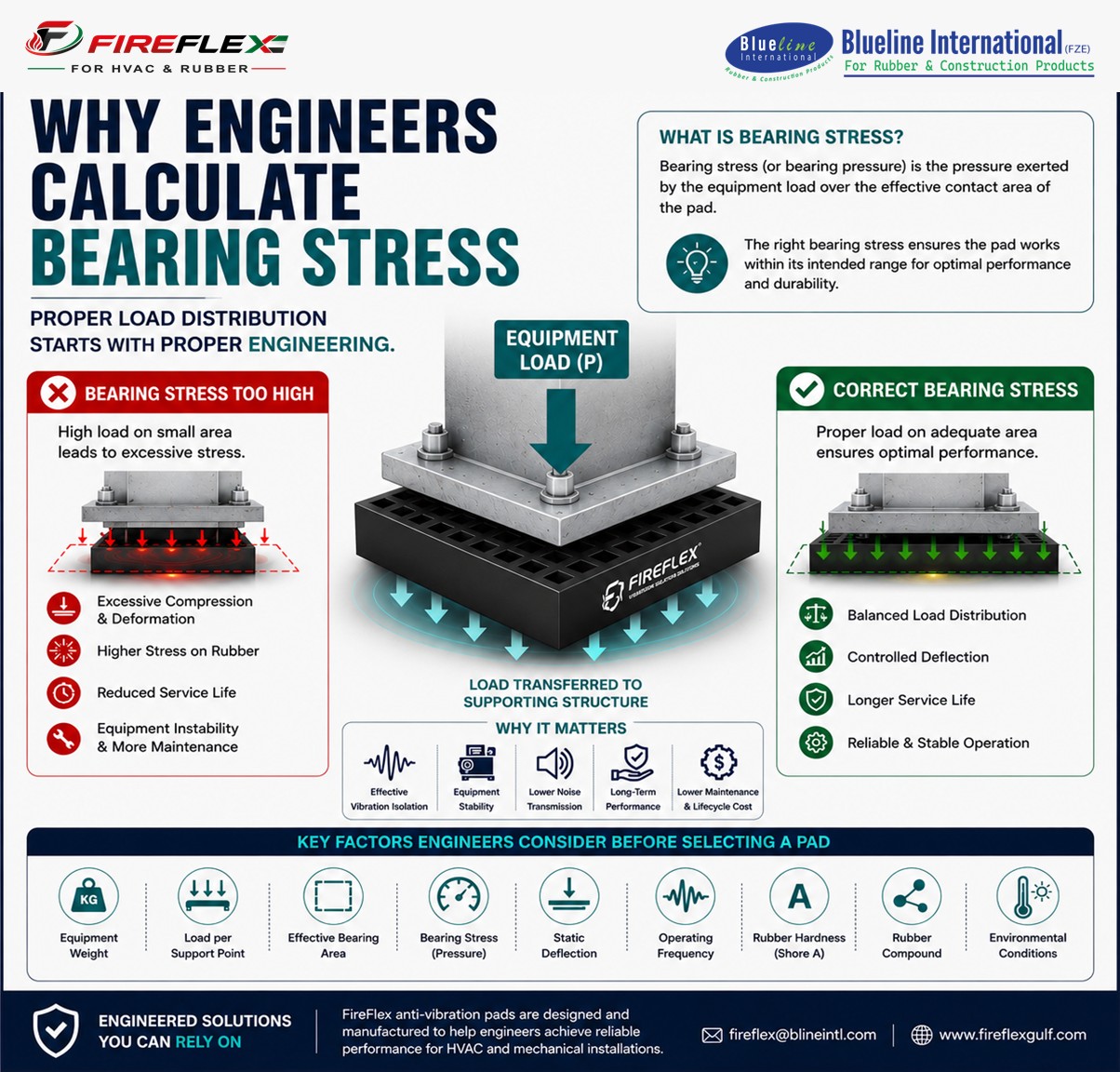
One of the most important engineering checks is bearing stress, which helps determine whether the load applied to the pad is appropriate for its contact area.
For consultants, MEP engineers and mechanical designers, understanding bearing stress is essential for selecting a vibration isolation solution that performs reliably throughout the life of the equipment.
What Is Bearing Stress?
Bearing stress is the pressure created when the equipment load is transferred through the pad to the supporting surface.
It depends on two primary factors:
- Applied load
- Effective bearing area
Evaluating this relationship helps engineers determine whether the selected pad is suitable for the intended application.
Why Bearing Stress Matters
An appropriate bearing stress helps support:
- Stable equipment installation
- Predictable pad performance
- Controlled deformation
- Effective load distribution
- Long-term durability
If the applied bearing stress exceeds the intended operating range, the pad may deform excessively or experience reduced service life.
Conversely, selecting an excessively large pad may increase cost and installation space without providing additional performance benefits.
Engineering Factors That Influence Bearing Stress
Before selecting an anti-vibration pad, engineers typically consider:
- Equipment operating weight
- Number of support points
- Load per support point
- Pad dimensions
- Contact area
- Rubber compound
- Shore A hardness
- Static deflection
- Operating frequency
These parameters should be evaluated together to select an appropriate vibration isolation solution.
Typical Applications
Bearing stress calculations are commonly performed for:
- Chillers
- Air Handling Units (AHUs)
- CRAH Units
- CRAC Units
- Pumps
- Cooling Towers
- Standby Generators
- Compressors
- Industrial Machinery
FireFlex Engineering Support
FireFlex provides engineering support to consultants, MEP contractors and project engineers by assisting with:
- Equipment load assessment
- Bearing stress evaluation
- Pad size recommendations
- Static deflection review
- Product selection for HVAC and mechanical systems
Our objective is to help customers select vibration isolation solutions that match project requirements rather than relying on generic product sizes.
Planning an HVAC or Mechanical Project?
Need assistance selecting the correct anti-vibration pad?
FireFlex can help review equipment loads, support arrangements and project specifications to recommend an appropriate vibration isolation solution.
Frequently Asked Questions
Why do engineers calculate bearing stress?
Bearing stress helps determine whether the equipment load is appropriate for the pad’s contact area, supporting proper product selection and long-term performance.
Is bearing stress the only factor in pad selection?
No. It should be evaluated together with load distribution, static deflection, operating frequency, rubber compound and environmental conditions.
Does a larger pad always reduce problems?
Not necessarily. An oversized pad may reduce bearing stress but can increase cost and may not provide additional vibration isolation benefits.
